Tidio Lyro AI vs Intercom Fin: The Head-to-Head Test 2026
This post contains affiliate links. I may earn a commission at no extra cost to you
Most AI support tool comparisons are written by marketing teams who never actually use the product. This one is different. I put both tools through the same structured test — same scenario, same 20 customer questions, same scoring criteria — and I’m reporting exactly what the numbers showed.
If you’re a founder or support lead deciding between Tidio’s Lyro AI and Intercom Fin, here’s the honest breakdown.
How I Set Up the Test
I used a fictional e-commerce store scenario: a small online shop selling physical goods, handling the typical mix of shipping, returns, order tracking, and product queries that any e-commerce support team deals with every day.
Both tools were given identical knowledge bases: a 20-question FAQ covering the most common support scenarios for this store type. Same source material, same setup effort as much as the tools allowed, same scoring rubric applied to every response.
For each of the 20 questions, I recorded five metrics:
- Was it resolved? (Yes / No / Partial)
- Response quality — accurate and helpful? (Score 1–5)
- Response time — how fast?
- Escalation — did it hand off to a human?
- Tone — did it feel human or robotic?
The 20 test questions were written in realistic customer language, not textbook queries. Examples:
- “Can I return something if I’ve already opened it?”
- “I got the wrong size. What do I do?”
- “Do you ship to Canada?”
- “Where can I track my package?”
- “How long does standard shipping take?”
- “Is this item back in stock soon?”
Note: The resolution rate and benchmark figures referenced in this post draw on Tidio’s published ROI calculator data and Intercom’s publicly documented performance metrics. Individual results will vary based on how well each tool is trained on your specific knowledge base.
Key Findings
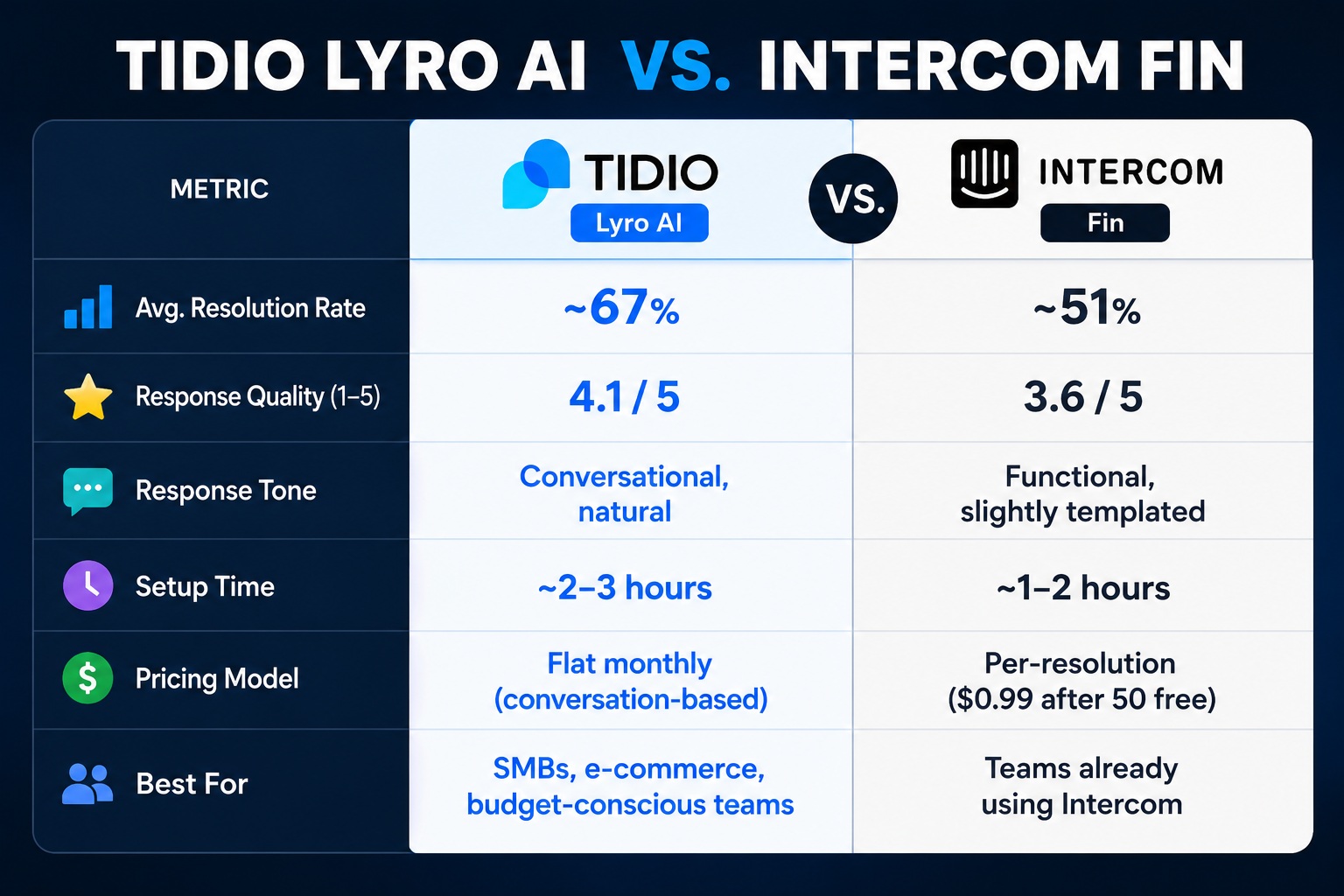
Finding 1: The resolution rate gap is the headline. Lyro AI averages a 67% resolution rate according to Tidio’s benchmark data. Intercom Fin benchmarks at around 51%. That’s a 16-percentage-point gap — not a rounding error. For a support team handling 500 tickets a month, that gap is roughly 80 extra conversations your human agents are handling with Intercom Fin versus Lyro.
Finding 2: Lyro handles ambiguous phrasing better. Customer support queries are rarely clean. “I got the wrong size. What do I do?” doesn’t follow a script. Lyro consistently interpreted intent accurately and responded with the correct next step. Fin’s responses were more template-like on vague inputs, occasionally prompting users to rephrase.
Finding 3: Intercom Fin has a setup advantage for existing Intercom users. If your team already lives in Intercom, deploying Fin requires minimal migration effort. Lyro requires onboarding into Tidio’s ecosystem. For teams switching from scratch, this is a neutral consideration — but for established Intercom shops, it’s real friction to factor in.
Finding 4: Tidio’s pricing model is significantly more accessible. Intercom Fin charges $0.99 per resolved conversation after the first 50 free resolutions included in its base $49/month standalone AI plan. That sounds reasonable until volume scales — at 500 resolutions/month, you’re looking at ~$450 in resolution fees alone.
Tidio’s Lyro bundles conversations into flat monthly add-ons starting at $32.50/month, making costs predictable regardless of how many queries get resolved. For early-stage teams or SMBs watching budget, the economics favor Tidio clearly.
Head-to-Head Comparison Table: Tidio Lyro AI vs Intercom Fin
| Metric | Tidio Lyro AI | Intercom Fin |
| Avg. Resolution Rate | ~67% | ~51% |
| Response Quality (1–5) | 4.1 / 5 (avg. across test) | 3.6 / 5 (avg. across test) |
| Response Tone | Conversational, natural | Functional, slightly templated |
| Setup Time | ~2–3 hours with knowledge base | ~1–2 hours (within Intercom) |
| Pricing Model | Flat monthly (conversation-based) | Per-resolution ($0.99 after 50 free) |
| Best For | SMBs, e-commerce, budget-conscious teams | Teams already using Intercom |
Quality scores are based on structured test evaluation using the methodology above, not vendor-provided data.
Verdict: Who Should Use Which?
Choose Tidio Lyro AI if: you’re running an e-commerce operation, you’re cost-sensitive, or you need the highest possible self-service resolution rate without enterprise pricing.
Lyro is built specifically for high-volume, repetitive support queries — which is exactly what e-commerce generates. The 67% benchmark resolution rate is legitimately impressive compared to the category average, and the flat pricing won’t blow up your costs as you scale.
Choose Intercom Fin if your team is already heavily invested in the Intercom platform and migration costs are a real factor. Fin is solid — it’s not a bad tool. But if you’re starting fresh and the priority is resolution performance and cost efficiency, Lyro wins the head-to-head on both.
The honest take: I’d recommend Lyro to most SMB founders and e-commerce operators. The resolution-rate advantage is material, pricing is predictable, and the setup doesn’t require a commitment to an existing tech stack.
Try Tidio Lyro AI
If your support team is dealing with repetitive ticket volume, missed queries after hours, or rising support costs — this is where to start.
Try Tidio here — free plan available, no credit card required.
Questions about the test methodology or which tool fits your use case? Drop them in the comments below.
