The Multi-Country Payroll Compliance Checklist That Prevents Six-Figure Mistakes
This post contains affiliate links. I may earn a commission at no extra cost to you
A single misclassified worker can cost a growing company more than a year’s worth of the savings that hiring them as a contractor was supposed to deliver.
In the United States alone, total exposure from one misclassified worker can run $15,000 to $100,000 or more once back taxes, penalties, interest, and legal fees are added up, depending on the facts of the case, and one finding can trigger audits across one or more agencies. Add a second country to the payroll, with its own tax authority, labor code, and filing calendar, and the same mistake multiplies rather than repeats.
This is the reality for most companies scaling past their first country. Payroll compliance is not one problem; it’s a different problem in every jurisdiction, and the rules are moving faster than most internal HR teams can track.
Governments are accelerating digital and real-time reporting mandates. IRIS Global’s 2026 payroll compliance analysis projects that more than three-quarters of tax authorities worldwide will be enforcing real-time or near-real-time payroll reporting this year, which would mean errors surface immediately instead of during year-end reconciliation, though this is one industry projection rather than a confirmed global count. What worked as a compliance process last year is not guaranteed to hold up this year.
Why One Payroll Playbook Doesn’t Travel
Copying a single country’s payroll process across every market a company hires in is one of the most common and most expensive mistakes in global expansion. Contribution rates, filing cadences, and penalty structures vary enough between countries that a process built for compliance in one jurisdiction can create real exposure in the next.
The table below shows how differently the same underlying obligation (correct classification, correct withholding, correct reporting) plays out once you cross a border.
| Jurisdiction | Statutory Requirement | Non-Compliance Penalty | Filing Cycle |
| Philippines | Pag-IBIG: 1% employee up to ₱1,500 monthly compensation, 2% employee above that, plus 2% employer, computed on a ₱10,000 maximum fund salary (₱200 max per side) | Fines plus retroactive contribution liability | Monthly |
| Germany | Pay-band disclosure and gender pay-gap reporting under the EU Pay Transparency Directive | No final national law yet; early proposals reportedly discuss fines up to €500,000 | Annual reporting |
| France | Same directive; pay-equity index and salary-range disclosure in job ads | Not yet finalized; draft rules reportedly include penalties up to 1% of total payroll | Annual reporting |
| Slovakia | Same directive; one of only four states to transpose it on the June 7, 2026 deadline | Roughly €4,000 per breach in early guidance | Annual reporting |
| United States | Correct W-2/1099 classification and federal + state payroll tax withholding | $15,000–$100,000+ in combined back taxes, penalties, and interest per misclassified worker | Per pay period |
Case Study: The EU Pay Transparency Directive
The Directive was adopted at EU level in 2023 and gives a clear picture of how uneven multi-country compliance really is in practice.
Every one of the 27 EU member states was required to transpose it into national law by June 7, 2026, mandating salary-range disclosure in job postings, gender pay-gap reporting, and an employee’s right to request pay data for comparable roles.
As of the deadline itself, only four member states (Slovakia, Italy, Lithuania, and Malta) had fully transposed it into law. Greece has since completed its own transposition, and as of early August 2026 the remaining member states are spread across partial implementation, published drafts awaiting adoption, or no draft at all. It’s a status that keeps shifting month to month rather than settling.
The penalty ranges under discussion vary just as widely as the timelines, and most are not yet locked in. Early national guidance points to fines as low as roughly €4,000 per breach in Slovakia (one of the four states that transposed on time), while Germany’s proposals reportedly discuss fines up to €500,000 and France’s draft rules reportedly include penalties of up to 1% of total payroll.
Neither is finalized as enacted law at the time of writing. A company with employees across five EU countries is, in effect, tracking five different compliance timelines and five different draft penalty schedules for what is nominally a single directive.
That’s precisely the kind of fragmentation that turns “we’re compliant” into a country-by-country question rather than a company-wide answer, and it’s worth reconfirming against a live tracker before acting on specific figures.
Misclassification: The Costliest Cross-Border Mistake
Worker classification is where multi-country payroll risk concentrates hardest, because the test for who counts as an employee versus a contractor is different in nearly every country, and getting it wrong is expensive almost everywhere.
Rise’s 2026 Global Payroll Compliance Report estimates that up to 30% of U.S. employers have misclassified at least one worker. In the U.S. specifically, IRS guidance under IRC Section 3509 can apply reduced rates in certain unintentional-misclassification cases.
Commonly cited ranges include a $50 penalty per unfiled W-2, 1.5% to 3% of the wages paid, and 20% to 40% of the FICA taxes that should have been withheld, but these are not universal outcomes; whether reduced rates apply, and the exact amount owed, depends on the specific facts of each case.
If the misclassification is found to be willful, those reduced rates do not apply: the company can become liable for the full unpaid FICA taxes, plus penalties and potential personal liability for company officers.
The numbers compound quickly. One reported case involved a small accounting firm with 15 misclassified workers facing roughly $385,000 in total liability after an IRS audit covering three years of back taxes, penalties, and interest, for a single classification decision applied consistently across a small team.
Multiply that risk across several countries with their own classification tests, and the case for getting it right before the first payroll run, not after an audit, becomes hard to argue against.
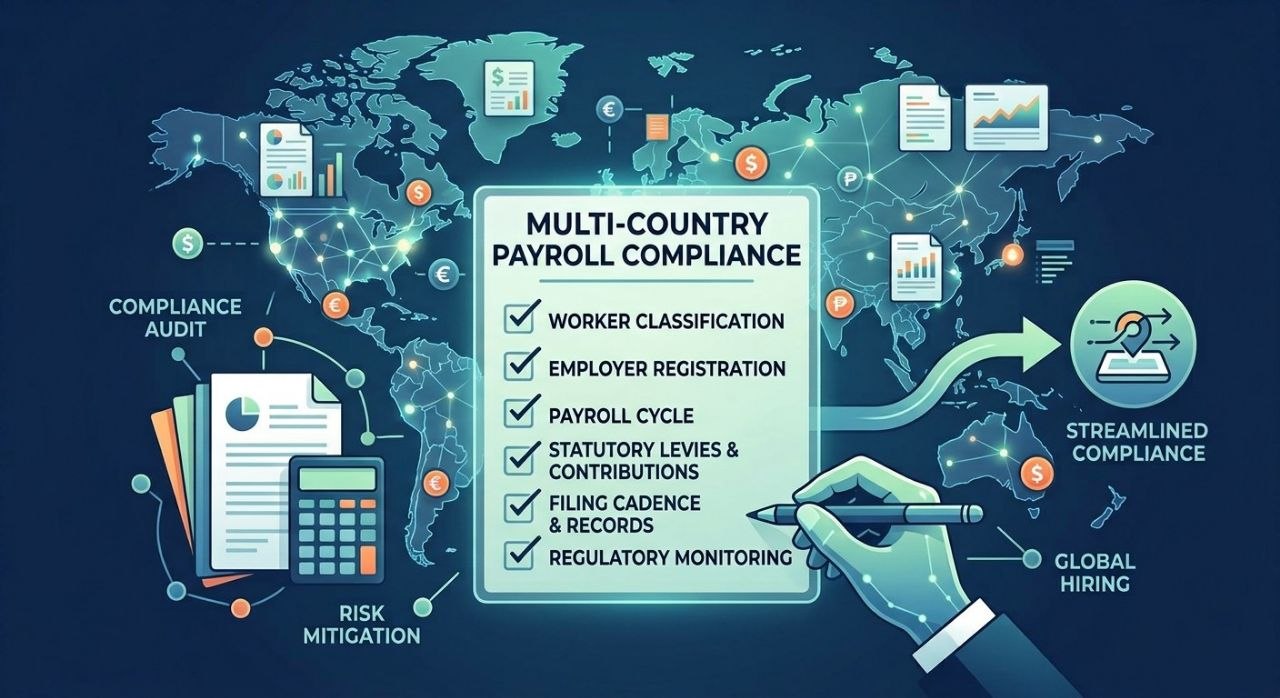
The Universal Compliance Checklist
Before getting into country-specific rules, there’s a baseline set of checks that applies in virtually every jurisdiction a company hires into. Running new markets against this list first catches the most common and most costly gaps before they become penalties.
| Checklist Item | What It Verifies |
| Worker classification | Employee vs. contractor status is documented and defensible under the specific test used in that country — not just the U.S. IRS test. |
| Employer registration | A legal entity or Employer of Record relationship is established in-country before the first payroll run, not after. |
| Payroll cycle | Pay frequency matches local legal minimums (weekly, bi-weekly, or monthly) rather than a single global default. |
| Statutory deductions | Income tax withholding, social contributions, and local levies are calculated at the current, correct rate for that jurisdiction. |
| Filing cadence | Tax and social-contribution filings are tracked by their actual local deadline — monthly in some countries, quarterly in others. |
| Data privacy | Payroll data handling meets local privacy law (GDPR in the EU, and equivalent regimes elsewhere). |
| Audit-ready records | Documentation proving how pay was calculated and when filings were made is centralized, not scattered across local teams. |
| Regulatory monitoring | A standing process exists to catch rate, band, and reporting changes — since requirements shift year to year, not just at hiring. |
Closing the Gap Without Building an In-House Team in Every Country
Most companies don’t have the headcount to track statutory rates, filing deadlines, and classification tests across a dozen jurisdictions in-house. That’s why the fastest-growing lever in this space is the Employer of Record model.
An EOR takes on the legal employer role in a country where a company has no entity, handling in-country payroll, tax filings, statutory contributions, and classification on the company’s behalf. It’s a large enough shift that the global EOR market reached an estimated $4.7 to $5.6 billion in 2025 and continues growing at roughly 6.5% a year, driven almost entirely by this exact compliance gap.
Deel states it supports global hiring and payroll coverage in 150+ countries, though available services vary by country and product (Deel’s own payroll-specific pages cite 130+ countries). Automated tax filings, statutory contributions, and payslip generation are included where available. If multi-country compliance is the thing keeping your next hire on hold, it’s worth checking coverage for your specific markets directly: see how Deel handles multi-country payroll compliance.
