Where AI Hiring Stops and Compliance Risk Begins
This post contains affiliate links. I may earn a commission at no extra cost to you
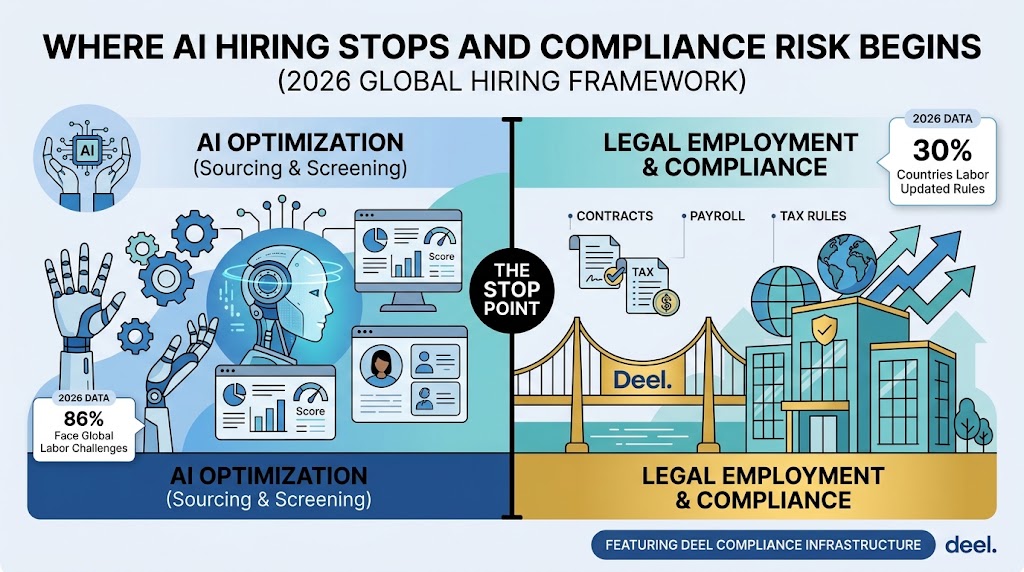
AI can find and screen your next hire in any country. It can’t make hiring them legal.
Every company building its 2026 hiring stack seems to have the same lineup: an AI sourcing tool, an AI screening tool, maybe an AI interview assistant. What almost none of them have is an answer to a much simpler question — once the AI finds the right person in another country, what actually makes it legal to hire them?
That gap is not a technicality. It’s where the real cost of “AI hiring” shows up, usually months after the AI part felt like a success.
The AI hiring stack, mapped
Most “AI hiring” conversations treat AI as one thing. In practice, it’s a stack of separate layers, and each one has a hard stop:
| Layer | What AI does here | Where it stops |
| Sourcing | Resume parsing, candidate matching, outbound outreach | Doesn’t verify the candidate’s legal eligibility to work |
| Screening | AI interviews, skills assessments, resume ranking | Doesn’t check local labor law or hiring compliance |
| Scheduling | Automated interview coordination and logistics | No employment contract logic behind it |
| Decisioning | Predictive scoring, bias flagging | Responsibility for the hiring decision stays primarily human |
| Onboarding & employment | — | This is where compliance infrastructure takes over |

The pattern in the data backs this up. Recruiting is the leading use case for AI in HR, but adoption overall is still uneven — and it’s concentrated well before the point where legal risk starts.
| Where AI is actually being used | Adoption |
| Organizations that have implemented AI in HR | 39% |
| Leading HR use case: recruiting | 27% |
| Next: HR technology | 21% |
| Next: learning & development | 17% |
| HR pros reporting improved efficiency from AI | 89% |
Source: SHRM State of AI in HR 2026 (n=1,908 HR professionals).
- Recommended reading: The Multi-Country Payroll Compliance Checklist That Prevents Six-Figure Mistakes
What breaks when companies skip the last layer
Candidates don’t fully trust the AI layers either. Among US candidates with AI-interview experience, only 21% believe most employers are using AI responsibly and transparently, and 70% say AI wasn’t clearly disclosed before their most recent AI interview.
That’s despite 63% of US job seekers saying they’ve already sat through an AI interview in the past six months, per Greenhouse’s 2026 survey of 2,950 candidates across the US, UK, Ireland, Germany, and Australia. But candidate trust is the smaller risk. The bigger one is what happens after the offer goes out.
The AI part of hiring can move at software speed. The legal part can’t. A team that sources and screens a candidate in another country in days, then tries to hire them the same way they’d hire someone down the street, runs straight into a compliance gap that AI tools were never built to close:
| The compliance gap, in numbers | 2026 data |
| HR leaders who call international labor law compliance their top global workforce challenge | 86% |
| Companies planning expansion who say local tax/employment rules will be their hardest task | 87% |
| Contractor misclassification penalties in high-compliance regions | $100,000+ per worker |
| Countries that updated payroll, tax, or benefits rules in 2025–2026 | 30+ |
Sources: Rise 2026 State of Global Hiring; Deel Global Payroll Compliance Checklist 2026.
Two things in that table matter more than the rest. First, this isn’t a fringe risk — it’s the single challenge most HR leaders rank above everything else about hiring globally in 2026. Second, enforcement has changed: regulators are now explicitly folding cross-border and remote contractors into reclassification actions, not just domestic ones. A contractor arrangement that felt safe in 2023 doesn’t automatically stay safe in 2026.
Why this is a stack problem, not an AI problem
None of this is an argument against AI in hiring — the efficiency gains are real, and 89% of organizations using AI in HR report greater efficiency. The point is narrower: AI optimizes the layers of hiring that are about finding and evaluating people. It was never built to solve the layer that’s about legally employing them once you’ve decided to hire.
That’s a different category of problem, and it needs different infrastructure — one that handles employment contracts, payroll, tax withholding, and statutory benefits correctly in whichever country your candidate happens to live.
Where compliance infrastructure fits in
This is the layer Deel operates in. Where an AI sourcing or screening tool stops at “here’s your candidate,” Deel’s Employer of Record and global payroll infrastructure picks up from there — offering compliant employment contracts, local tax and payroll handling, and statutory benefits administration across 150+ countries, without you needing to stand up a legal entity in each one. As with any EOR, the specifics depend on the country and the details of the hire, but this is the category of infrastructure the compliance gap above calls for.
Put simply: the AI half of your hiring stack finds the person. The compliance half is what lets you actually hire them.
See how Deel enables global hiring
The bottom line
The AI hiring stack isn’t broken — it’s just incomplete. Sourcing, screening, and scheduling can all run on AI. Legal employment can’t. The companies that get this right in 2026 aren’t the ones with the most AI tools; they’re the ones that pair AI speed on the front end with real compliance infrastructure on the back end.
